June 30, 2015 – WILD & REMOTE YUKON
The day started with meeting an amazing lady who runs the Johnson Crossing Café and Campground. Cheery with an awesome attitude it was pleasant to chat with such a nice cheery person. Her café was beautiful inside and filled with trinkets for sale including some great Alaska books as well as fresh baked goods. I am guessing but I think it was her Dad in the back cooking and baking, just the way they interacted with each other.
She took my 7 day unwashed coffee mug into the back and gave it a good cleaning before pouring me a Yukon style cup of coffee. I had a few niblets of the fresh baked goods they were sharing with the customers and the Cinnamon Bun was something special! I wasn’t in the mood for breakfast but the coffee and shopping around in this nice place was a change of pace!
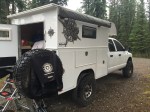
I heard a ruckus of dogs barking and talking to each other and outside in the parking lot a Dog Sled Team had arrived in trucks and trailers and they were running the dogs one by one. Diezel stuck his big head out the window and barked at them talking a mile a minute probably saying, “hey, come over here we are on vacation, we swim multiple times a day, we eat dinner with this big guy, I got him roped into whatever I want, come boys come with us!” I just laughed and shoed Diezel into his own backseat and fired up CASPER!
Back to the Alaska Highway!
On paper they claim it’s 1500-miles, but over the road it seems about 15,000 miles. One lane going in each direction with a yellow stripe down the middle and a handful of gas stations that you better not miss when you blink. That’s about the nature of the Alaskan Highway.
In 1943, US President Roosevelt convinced Canada it was in our best interests to share a road from the United States through Canada to Alaska in order to supplement US military installations because of the conflict with Japan. The Canadian Prime Minister agreed if the United States paid for the entire project. A combined effort of some 25,000 troops, laborers and locals took only 9 months to complete the project at the tune of $150 million dollars and the original Alaskan Highway was completed.
When you think about the year, the technology and the weather its actually amazing they accomplished this project in only 9 months.
The road is not very wide and not much wider then Mexico’s Baja Peninsula Highway 1. The Alaskan Highway has shoulders most of the time while Mexico Hwy 1 does not.
However, the Alaskan Highway is a raised highway in 90% of the locations so a mistake and it could be trouble. After driving the Alaska Highway its certainly much more remote than anything in North America. For several hundred miles there is nothing and nothing. And when you do see a sign for services of some sort you cannot be sure they are still in business.
This is the real deal wild in North America … the most harsh weather conditions surrounded by wild animals and everyone fending to survive and be prosperous. Small encampments are just that…a camp not really a town. The only really town is Whitehorse, Yukon, NWT. The rest such as Watson Lake and so on only provide basic services and you can’t be sure of that. Surprising to me is the level of food. It’s expensive and is just the basic staple breakfasts and dinners, nothing special nothing different. I am not saying its bad, just saying I am surprised. Seems to me a killer spot serving great food would be off the hook for those traveling the highway.
And for the most part, it seems that 90% of the people working in the service industry at these small encampments are just there because they have to be. They are not nice, they don’t like the tourists, they do better with the truckers and locals traveling the highway, but the motorhomes and trailer blue hairs seem to annoy the service personnel. Except at Johnson Crossing north of the Teslin River, wow I spoke with a 30 year old gal who was just a dynamite personality and was nice to every single person in the café / store etc.
Up in the Yukon the businesses are one-stop shops for EVERYTHING. They are a café, gas station, store, post office, phone booth, mechanic garage, water store and so much more. You can be on the lookout for a café, but when you pull up you see the awesome new sign and also see a line of cars around back using the 1984 gas pumps at $5.75 a gallon.
Gasoline and Diesel are by far the #1 commodity in these parts. Stops can be 350-400 miles apart and I’ve seen several people stopped at abandoned gas stations looking with the wild stare as I drove by. They did’nt stop previously seeing a sign that advertised gas / diesel but that place went outta business a couple years ago.
CASPER runs a 73-gallon diesel fuel tank and at roughly 15 miles per gallon the long range mileage is about 1000 miles, but we still stop and fuel up at the main locations that are available just in case something happens at the next stop. You just never know.
Frost heaves are when the winter plays havoc on the asphalt and creates these big ass humps in the road where the road pushes upward from 1 inch to 24 inches. The bigger frost heaves are shaved down by the road crews but the smaller ones are left alone. You’re traveling along at a good clip and you see something sticking up and you think NAH it can’t be anything it’s a flat asphalt road and then you SEE it! Dang I got stopped this time and I have to slow it down!
My friend from Alaska, Scott Tally, who lives in San Diego nowadays, clued me into what these things were. Well it slowed me down a lot and that last 140-mile section of the Yukon portion of the Alaska Highway took 4 hours to complete because of the Frost Heaves and the endless gravel and dirt roads. It was a doozy.
We drove thru Beaver Creek, the last town in the Yukon before reaching the US / Alaska Border. 20 minutes later we were sitting two cars back from crossing back into the United States. A very warm 50-ish year old lady was the Customs Border Officer and asked a couple questions before chatting it up with Mr. Diezel and waving us by.
The US / Alaska border crossing, of course, is placed in the middle of nowhere forest. It’s 77 miles from the nearest town of Tok, Alaska. Not sure who was thinking what, but its definitely the US Government at its finest.
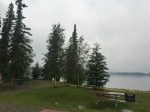
We stopped 30 miles down the road to have a coffee break and let Mr. Diezel stretch those long legs so he could run around and he was a happy camper. We made a SAT Phone call to the boss to let her know we crossed and everything was good. We cruised for another 40 miles before we found a cool campground, an Alaskan State Parks campground and not many people around. Seems the rain is keeping everyone inside!
Diezel checked out our camp as usual and we made our way into the comfortable XB Camper II. We clicked on a Major Motion Picture and ended up falling asleep to the rain pitter-patter on the roof.










It was another great day in our Alaskan adventure!

 Xplore The Wild